The Truth may set you free, but it may take awhile

The new knowledge in managing variation was classified during WWII, declassified after the war, and shared worldwide. It is still a relatively well-kept secret.  Test your knowledge? Can you handle the Truth?
LinkedIn Post.

 “All truth passes through three stages: first, it is ridiculed. Second, it is violently opposed. Third, it is accepted as self-evident.” — Arthur Schopenhauer

“One of the greatest pains to human nature is the pain of a new idea… Naturally, therefore, common men hate a new idea, and are disposed more or less to ill-treat the original man who brings it.” – Walter Bagehot

“The person who fights for a dying cause is admired, supported and honoured. The person who fights for a new cause struggling to be born is misunderstood, reviled and attacked. Nothing is more difficult than taking the lead in a new order of things.” — Dee Hock, Founder & CEO, Visa

Throughout history, people have been punished for saying something an institution or society could not allow to be true or could not even see.

Different centuries, different contexts, same human reflex.

The pattern continues in our organisations today

Galileo Galilei (astronomer & physicist)
His act: Demonstrated that the Earth orbits the sun, contradicting Church doctrine.
Outcome: Tried by the Inquisition (1633), forced to recant and lived the rest of his life under house arrest. The Church took over 300 years to formally admit he was right.

Ignaz Semmelweis (physician, early pioneer of antiseptic practice)
His act: Showed that handwashing with chlorinated water stopped doctors transmitting deadly infections from autopsies to maternity wards.
Outcome: Ridiculed, removed from his post, suffered a breakdown, committed to an asylum and died there from an infected wound. His insight was only accepted after his death.

General Billy Mitchell (U.S. Army aviation pioneer)
His act: Warned that air power would define future warfare and criticised military leaders for neglecting aviation readiness.
Outcome: Court-martialled for insubordination, suspended without pay and forced out. Decades later, WWII proved him correct and he was posthumously honoured.

Roger Boisjoly (NASA engineer)
His act: Warned that the Challenger O-rings would fail in cold weather and urged NASA to delay the launch.
Outcome: After the disaster proved his warning correct, he was shunned and sidelined within his company. Later honoured in ethics circles, but his career there never recovered.

Sinéad O’Connor (musician & activist)
Her act: Protested sexual abuse in the Catholic Church on live television in 1992.
Outcome: Ridiculed, boycotted and condemned for years. Later reinterpreted as someone who named a truth long before society recognised it.

Stanislav Petrov (Soviet lieutenant colonel & air-defence officer)
His act: In 1983, he judged a Soviet nuclear warning to be a false alarm and refused to escalate — preventing a likely nuclear exchange.
Outcome: Reassigned to a lower-level post, denied the commendation he was promised and quietly moved into early retirement. Only after the USSR collapsed was his decision publicly honoured.

The truth-teller becomes the problem long before the truth becomes accepted.
 

Religious ‘nones’ would outnumber Protestants among young people in ‘small town’ America

This post at Linkedin.

Religious ‘nones’ would outnumber Protestants among young people in ‘small town’ America: Pew
By CP Staff

Would Christianity still dominate the United States if it were reimagined as a small town of 100 people?

How about framing the issue (belief in God) a little differently? What philosophy or worldview produces the best results?

Knowledge and understanding of variation provide a proven standard for assessing whether change results in improvement. A “None” cannot conclude that variation does not exist.

In a Christian worldview, continuous improvement by reducing variation from the ideal (more perfect) is a moral imperative where good enough never is. This philosophy influenced the design of the American Constitution and system of government. What is the competitive advantage of other philosophies?

Information on Variation at: SuccessThroughQuality.com

The Golden Age of Humanity?

The Golden Age of Humanity? We’re Living in It. Modernity is more meaningful and moral than medieval Christendom. By Steven Pinker and Marian L. Tupy, 11.24.25 — The Free Press

Post at Linkedin

The article presents the argument for secularism. The counter-arguments are provided in the comments. One area of consensus may be to the statement: “Our moral purpose, then, is to use knowledge and sympathy to reduce suffering and enhance flourishing: health, freedom, peace, knowledge, beauty, social connection.”

The Christian worldview holds that God is love and that love is willing the good of others. “Love is not a feeling but an act of will.”

A “more perfect Union” could be described as one in which more needs are met, thereby reducing the harm caused by unmet needs. Consequently, continuous improvement becomes a moral imperative. Take crime, for example: the less crime, the fewer people who are being harmed.

Whether you believe in God or not, a moral imperative would be to reduce the gap between the ideal (all needs met) and the actual situation.

Successful actions, including determining whether change results in improvement, can be supported by quality management methods and tools.
The Taguchi Loss Function reinforces that the closer any product or service gets to the ideal or target, the better the quality and the lower the cost to the individual and society.

Fossilized Faith

Post at LinkedIn.

Fossilized Faith by Aaron Reen, Nov 14, 2025.  I have a review of sociologist Christian Smith’s important new book Why Religion Went Obsolete: The Demise of Traditional Faith in America in the new December issue of First Things magazine.

“As Smith writes, obsolescence doesn’t mean extinction”. .. religion is just “less relevant to mainstream society”. Smith and Renn make the case that the “method” (“fossilized forms”—of traditional religion) of communicating the message is certainly becoming less relevant.

The topic of obsolescence is a little surreal to me. The expectations from a belief in the Christian message are timeless. God is love; love is willing the good of others, followed by taking the appropriate actions.

In the American system of government, the responsibility of citizens is to work together toward that more perfect union, which includes providing products and services as employees, entrepreneurs, elected officials, business owners, and ministers, where everyone benefits or at least, is not any worse off.

Meeting expectations requires reducing variation from the ideals advertised through promotions, marketing, and electioneering.

In a different context, how many parents and guardians who love their kids do not take the action needed to do what they think is best for them? Who doesn’t like to be the recipient of a kind word or deed?

Excellent quality results from doing the right things (effectiveness) and doing them right (efficiency). How can the management of quality ever be “obsolete”? Some people may always associate their motivation to do good with a higher power (God or a God), and others won’t – nothing new or obsolete about that. What “method” produces the best results for everyone?

Linkedin: “We have been subverted”

This post at Linkedin.

Ayaan Hirsi Ali: We Have Been Subverted. The Free Press.“What is at stake in our ability to see the threat plainly? Nothing less than the preservation of our way of life.”

From a Biblical worldview, the subversion is spiritual and started in the Garden of Eden when mankind was deceived by the belief that they could be God.

The U.S. system of government (a Republic) is exceptional in that Judeo-Christian principles influenced its design. These principles enable “We the People” to work together towards that “more perfect Union.”

The quality management technology provides the methods and tools to support both a secular and non-secular approach to improvement.

https://lnkd.in/gSJrGKmE

Linkedin: “How Intellectuals Found God”

Posted at LinkedIn – Oct 9, 2025

12.28.24 — The Big Read,  The Free Press, How Intellectuals Found God
Almost 150 years after Nietzsche said ‘God is dead,’ some of our most important thinkers are getting religion. Peter Savodnik meets the new theists.

W. Edwards Deming introduced an additional convincing argument for the belief in God. Deming recognized that an inherent part of God’s design is variability. Reducing the variation from God’s standard of perfection (where all needs are met) meets the expectations God has for his faithful servants.

Deming has been referred to as a Prophet of Quality who supported a secular approach to improvement. His contributions were recognized by Fortune magazine as being among the 20 that have shaped the modern world of business and by U.S. News and World Report as one of nine turning points in history. The top turning point was identified as “The Apostle Paul, whose preaching and eloquent writings led to mass acceptance of Christianity.”

Deming’s experiences were similar to the Prophet Isaiah (Isaiah 6:9-10), where the simplicity and truth of the message lead many to “Keep on hearing, but do not understand; keep on seeing, but do not perceive. “

The quality profession, through the Taguchi Loss Function, has reinforced that the closer any product or service gets to the target or ideal (more perfect), the higher the quality and the lower the cost to the customer and society.  Deming referred to this as a Chain Reaction: “When you improve quality, costs decrease, productivity improves, capture the market with better quality and lower costs, stay in business, create jobs, and more jobs. “  https://lnkd.in/gc3egWgB

Every occupation is a form of ministry

You Are a Priest in God’s Kingdom, by Jimmy Evans, May 7, 2023.

Our roles as priests today, and how the roles will change at the Rapture

This post at LinkedIn. 

A Biblical Truth. “Every occupation is a form of ministry, and God has given all of us work to do.” The purpose of any product or service is to meet a need. Variation is a natural part of God’s design and represents the gap between the perfect (all needs met) and the imperfect, reflected by the current situation.

The secular quality profession has validated through the Taguchi Loss Function that the closer any product/service gets to the target (more perfect) as defined by the customer, the higher the quality (more needs met) and the lower the cost to the individual and society.

W. Edwards Deming was a world-recognized leader in quality management and a devout Christian. He remarked that if he was to reduce his message to just a few words, it all has to do with reducing variation.

Ironically, the need for continuous quality improvement is an accepted practice in “secular” industries throughout the world, yet little to no awareness that reducing variation is “a form of ministry.”

In the Christian community, the most common statement I hear from pastors and scholars is that continuous quality improvement is just a “business thing” and irrelevant to ministry. In America, “We the People” are responsible for working towards that “ more perfect Union” by reducing variation. Additional context on the topic: https://lnkd.in/edH5C4d

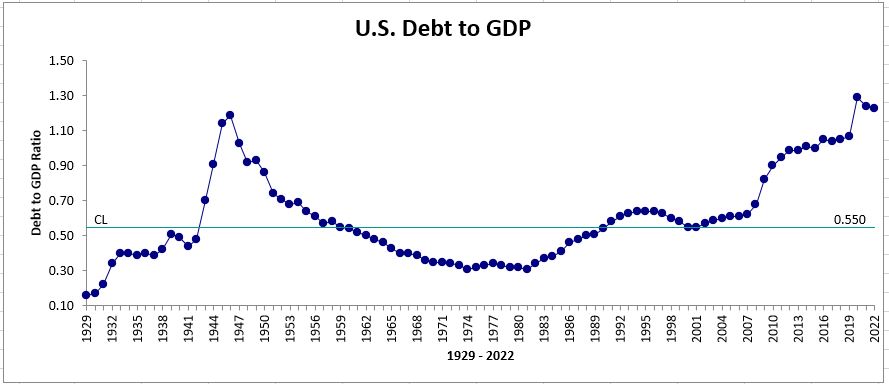
U.S. Debt to GDP 1929 – 2022

Debt to GDP Ratio 1929 2022

Post at Linkedin.

US National Debt by Year, By Kimberly Amadeo, Updated on January 18, 2023. Reviewed by Robert C. Kelly,  Fact checked by Emily Ernsberger.

Reversing Course – Learning from the past. In 1946, the U.S. Debt to GDP ratio was 119%. This was at a time following WWII when national resources were dedicated to the war effort. This ratio was exceeded for the first time in 2020 at 129% and was 123% in 2022.

After WWII, the U.S. owned half the world’s markets. Pent-up demand for manufactured goods created a middle class and led to reductions in the debt-to-GDP ratio to as low as 31% in 1981.  Global competition and failure to understand and adopt the better quality management methods pioneered by W. Edwards Deming (that ironically were classified during WWII), continue to contribute to a loss in American productivity and competitiveness.

Ironically, although the quality methods were de-classified after the War, they continue to be a well-kept secret in America. The solution? Apply the better methods that will result in what Deming referred to as a Chain Reaction – improve quality, costs decrease, productivity improves, capture the market with better quality and lower costs, stay in business, create jobs and more jobs.   The additional context is provided at: https://successthroughquality.com/

April 21, 2020. U.S. Debt to Surge Past Wartime Record, Deficit to Quadruple, By Christopher Condon and Dave Merrill

US Debot projection 1940 to 2025

Christian Nationalism – A Simple Test?

How Much of a Christian Nationalist Are You? Take This Simple Test. Scott Hogenson | Jan 29, 2023

Post at Linkedin

A different question? What actions by individuals and groups produce the best results for everyone? Variation is a natural part of creation. The Constitution identifies the aim of the U.S. system of government as working towards “a more perfect Union.” There will always be a gap between the current reality and the “perfect” situation.

How do “We the People” (top management) define more perfect? What feedback is needed to assess results? How will we know that a change will result in an improvement?

A Christian worldview supports the premise that actions motivated by love result in more needs being met. This leads to fewer people being harmed by unmet needs. In contrast, more centralization of political power through the erosion of the checks and balances on power has been proven throughout history to result in more harm than good.

The quality profession through the Taguchi Loss Function has validated that the closer you get to “more perfect,”  the higher the quality and the less harm to individuals and society.   Improvement in any aspect of life all has to do with reducing variation. A summary of the concept at the following: successthroughquality.com

Avoiding Spiritual Plateaus

Post at LinkedIn

There are no spiritual plateaus

Exclusive: Greg Laurie warns readers not to put ‘the Christian experience on cruise control’

Variation is a natural part of God’s creation and represents the gap between the ideal or more perfect and the actual situation.

Variation either gets better or gets worse which makes continual improvement imperative if the goal is better results.

The quality profession through the Taguchi Loss Function has validated that continually reducing variation leads to better quality with fewer negative consequences on the individual and society.

Within the Christian community, a common perception is that continual improvement is more of a “business thing.” The fact is that continually reducing variation is a moral imperative supporting the guidance that there should be no spiritual plateaus nor should learning be put on cruise control.

https://www.wnd.com/2023/01/no-spiritual-plateaus/