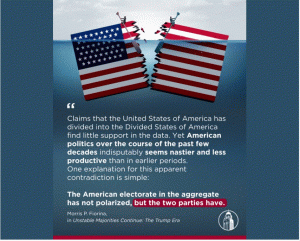
Book: Electoral Instability

Unstable Majorities Continue: The Trump Era

By: Morris P. Fiorina

The United States is experiencing a period of electoral instability unprecedented in our history. Neither of the two major political parties reflects the political will of the majority of Americans, who must choose between candidates holding positions more extreme than those of the typical voter. With no true centrist party, Republicans and Democrats take turns as the party in charge.

Unstable Majorities Continue: The Trump Era examines the current pattern of volatile party control that, from a historical perspective, is very unusual. It follows the author’s 2017 book Unstable Majorities, which identified this trend in analyzing the 2016 election.

In contrast to the relatively stable party majorities that characterized preceding eras, since 1992 the country has experienced a period of unstable institutional majorities, where presidential candidates have earned relatively narrow margins of victory and control of the House and Senate has fluctuated. For several decades now, the verdict from the voting electorate has often been one of no confidence in whatever institutional pattern of control prevails.

Why have American politics changed so dramatically? Fiorina states that the current nature of the country’s political conflicts is misunderstood. After reforms, societal changes, and political coalition-building, the Republican and Democratic parties of today are much different organizations from those that operated in the past, becoming more homogeneous internally and more distant from each other—and from the public—in policy and ideology. The parties have polarized; the electorate has not.

There are no indications that the 2024 elections have ended the era of unstable majorities. While the rise of populism contributes to present conflicts, it is a consequence more than a cause, with economic conditions ranking near the top of factors affecting party fortunes.

By examining data and voting behavior on abortion, gun control, environmental regulation, and other issues, Fiorina argues that voter positions have largely stayed moderate over time. He dispels the commonly held belief that American voters have become politically polarized, creating a “Divided States of America.”

About the Author

Morris P. Fiorina is the Wendt Family Professor of Political Science at Stanford University and a senior fellow of the Hoover Institution. His research focuses on public opinion and elections and how they relate to democratic representation.

Indiana Governor Braun order establishes Indiana faith-based institutions initiative, spearheaded by Beckwith’s office

Feb 26, 2026. INDIANAPOLIS — A new executive order from Indiana Gov. Mike Braun established the Indiana Faith-Based Institutions Initiative, a program that Braun stated in the order will be run by the office of Indiana Lt. Gov. Micah Beckwith.

The initiative aims at encouraging and fostering faith-based institutions to better serve individual Hoosiers, families and communities, according to Executive Order 26-06.

Through this initiative, Beckwith and the lieutenant governor’s office will be able to consult with experts and leaders of faith-based institutions that operate programs in specific areas to help identify areas to “reduce barriers to effective participation of faith-based institutions in addressing societal ills.”

The specific areas outlined in the order include:

  • Increasing civic engagement
  • Promoting recovery from substance use disorder
  • Facilitating prisoner reentry into society
  • Cultivating resilience through work and self-sufficiency
  • Strengthening the family unit
  • Mentoring the next generation
  • Promoting principled morals and character
  • Supporting foster parenting and adoption

The order stands that Braun’s administration believes that the state of Indiana’s “diverse and welcoming faith community” can help bring “unique skills, services and resources to assist with the struggles” that Hoosiers face.

Officials said they believe that these institutions have the capacity to serve in ways different from what government can provide, as well as with effectiveness that “often exceeds that of government.”

In a post on social media from Beckwith, he thanked Braun for moving forward with this program, stating that he is “humbled by his confidence” for his office to spearhead the initiative. Beckwith said he believes that Hoosiers will “benefit from this effort for years to come.”

“By promoting collaboration between state government and faith-based partners, the initiative aims to expand the reach of programs that help Hoosiers overcome addiction, reenter society after incarceration, strengthen their families, develop resilience through work and build meaningful lives rooted in purpose and service,” Beckwith said in the post. “These community-rooted institutions frequently provide forms of support that government alone cannot, and ensuring they are able to participate fully and freely is vital to the well-being of our state.

The order’s emphasis on safeguarding religious liberty and creating a fair, welcoming environment for all qualified service providers reaffirms Indiana’s long-standing commitment to both constitutional principles and community partnership,” Beckwith’s post continued. “Empowering organizations that uplift Hoosiers in times of need strengthens families, enhances civic engagement and broadens pathways to opportunity across our state.”